



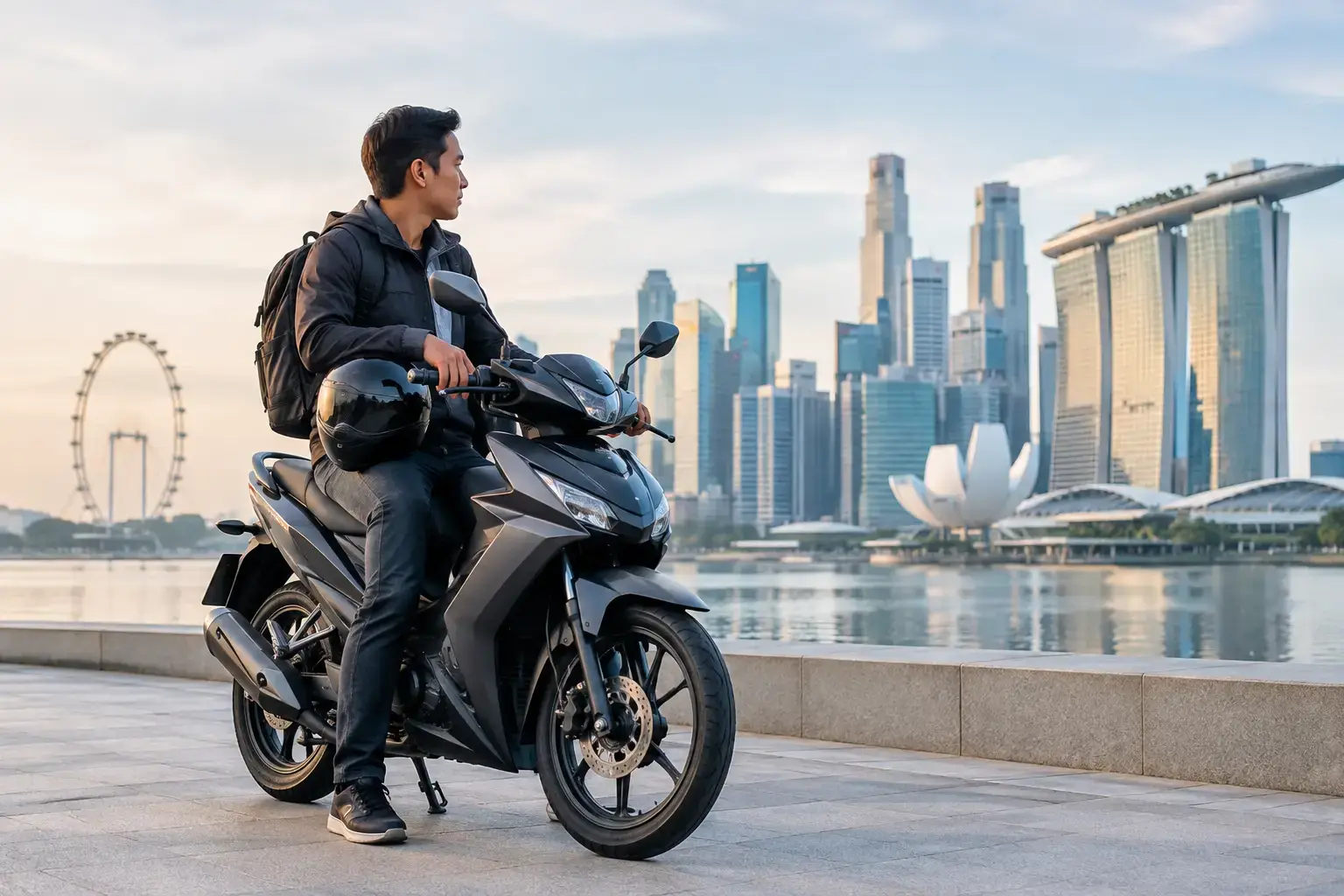
Commuter Motorcycle Cost Case Study in Singapore
A commuter motorcycle cost case study is most useful when it starts with the ride you actually make: the weekday trip to work, evening errands, rainy-day detours, parking, fuel, and the occasional workshop visit you did not plan for. For a Singapore rider, the headline price of a bike is only one part of the decision. The better question is how much dependable mobility costs each month – and how much uncertainty you are willing to carry.
This practical example compares three ways a rider can commute: owning a Class 2B motorcycle, taking a longer-term rental or lease, and renting only on the days a bike is needed. The figures are illustrative Singapore dollar estimates, not a quotation. COE values, insurance profiles, bike condition, parking, usage, and rental terms can change the answer substantially.
The Rider and the Commute
Meet Jay, a 24-year-old Class 2B rider with a P-plate license. He travels from the east to an office near the central area five days a week, with a round trip of about 32 km. He also uses the bike for groceries, visiting family, and one weekend outing most weeks. His expected distance is roughly 1,000 km a month.
Jay wants predictable transport, but he does not have a large cash reserve for a surprise repair. He has access to public transportation, so a motorcycle is convenient rather than absolutely essential every day. That detail matters. A rider who must be on the road for shift work has a different risk tolerance from someone who can take the train when needed.
For this example, fuel, parking, and occasional ERP charges are included in every option where Jay rides. Fines, accident excess, traffic violations, and optional accessories are not included. Those costs depend too heavily on the individual rider.
Commuter Motorcycle Cost Case Study: Three Routes
Option 1: Buy a used Class 2B motorcycle
Ownership gives Jay control. He can choose the bike, make it his daily transport, and ride whenever he wants without thinking about return times or rental availability. But ownership also puts maintenance timing, resale value, insurance renewal, and breakdown exposure on him.
Assume Jay buys a well-kept used 150cc Class 2B bike and keeps it for two years. Rather than treating the full purchase amount as a monthly expense, the case study uses the expected loss in value over the two-year period. That is the cost that matters if he later sells the motorcycle.
| Monthly ownership cost | Illustrative estimate | |—|—:| | Depreciation and resale-value loss | $190 | | Insurance for a younger rider | $115 | | Road tax and inspection allowance | $12 | | Routine servicing, tires, and wear items | $75 | | Repair contingency fund | $45 | | Fuel | $95 | | Parking and ERP allowance | $80 | | Estimated monthly total | $612 |
The $612 figure assumes the bike does not need a major repair. It also assumes Jay bought without a costly finance arrangement. If he uses financing, interest and administrative charges need to be added. If he suffers an engine issue, accident damage, or an early tire replacement, his real monthly average can climb quickly.
Ownership can still be the strongest value for a rider who plans to commute heavily for years, has savings for repairs, and is comfortable managing maintenance. It is less attractive when the purchase stretches the rider’s budget from day one. A cheap bike that needs repeated workshop visits is not cheap transport.
Option 2: Use a longer-term rental or lease
With a longer rental arrangement, Jay pays for access rather than taking on the motorcycle’s resale risk. The monthly rate may look higher than a bare-bones ownership calculation, but the comparison has to be fair. A properly maintained rental can include scheduled servicing, registration-related responsibilities, and support arrangements that an owner would otherwise fund or organize alone.
For this example, assume Jay receives a quoted longer-term rate of $650 a month for a commuter-friendly Class 2B bike. He still pays for fuel, parking, and ERP. His estimated outlay looks like this:
| Monthly rental cost | Illustrative estimate | |—|—:| | Longer-term rental or lease payment | $650 | | Fuel | $95 | | Parking and ERP allowance | $80 | | Estimated monthly total | $825 |
The difference from ownership is about $213 a month in this scenario. In exchange, Jay avoids tying up money in a bike, avoids resale uncertainty, and may have a clearer path when maintenance is needed. The value is not only financial. When a commuter has a busy work schedule, the time spent arranging repairs, waiting for parts, or selling a bike can carry a real cost too.
Terms decide whether this option works. Jay should confirm the mileage allowance, security deposit, accident excess, servicing coverage, collection or delivery options, replacement-bike policy, and what happens if the bike breaks down. A low advertised monthly number is not enough if the conditions do not match how he rides.
For riders who want flexibility without a long ownership commitment, Vroom Leasing offers maintained motorcycle rental options across Class 2B, Class 2A, and Class 2 categories, backed by roadside support. Ask for the current rate and included terms for the specific model instead of relying on a generic monthly estimate.
Option 3: Rent only for commuting days
Daily rental can make sense when motorcycle use is occasional, temporary, or tied to a short work assignment. It is also a practical way for a newer rider to test whether riding to work fits their routine before committing to a purchase.
The math changes fast when riding becomes a five-day-a-week habit. At a starting daily rate of $30, 22 weekday rental days alone come to $660 before fuel, parking, ERP, deposit requirements, or any add-ons. Using the same $175 allowance for fuel and parking, Jay reaches approximately $835 a month.
That is close to the longer-term rental example, but with more booking decisions and potentially less certainty about getting the same bike. Daily rental is usually not the low-cost winner for a full-time commuter. Its advantage is freedom: Jay can stop immediately when his work pattern changes, take public transportation during a rainy week, or rent only when he has a specific need.
What the Numbers Miss
A monthly total is useful, but it cannot capture every reason riders choose one option over another. The owner may save money over time but needs cash up front and must handle a sale later. The long-term renter pays more for convenience but may sleep better knowing routine maintenance is not a sudden personal bill. The occasional renter may pay the highest amount per day while avoiding months of expense when the bike sits unused.
Reliability deserves its own line in the decision. A $600 ownership budget is not a bargain if a breakdown makes you late for work twice in a month. Likewise, a rental arrangement is only worth its premium when the provider responds quickly, keeps bikes maintained, and explains responsibilities clearly.
Jay should also consider his license stage. A P-plate rider’s insurance cost can be notably different from that of an experienced motorcyclist. A Class 2A or Class 2 rider choosing a larger bike may face higher fuel use, rental rates, tire costs, and insurance. More power can be enjoyable, but the commuting budget should rise with it.
How to Make the Right Comparison
Before choosing, Jay should get three real figures: a purchase quote for a specific bike, an insurance quote in his own name, and a rental or lease quote with all included services stated in writing. He should then add his expected fuel, parking, and ERP costs to each option.
Use a realistic riding pattern, not the ideal one. If you expect to ride 22 workdays but know that you travel overseas, work from home, or take public transportation during heavy rain, factor that in. If you are likely to change jobs or upgrade license classes within six months, a flexible rental may be worth more than the lowest theoretical ownership cost.
The most affordable commuter motorcycle is not always the one with the lowest monthly estimate. It is the option that gets you to work consistently, fits your cash flow, and does not turn one workshop surprise into a financial headache. Start with the commute you have now, choose terms you understand, and leave enough room in the budget to keep riding comfortably.