



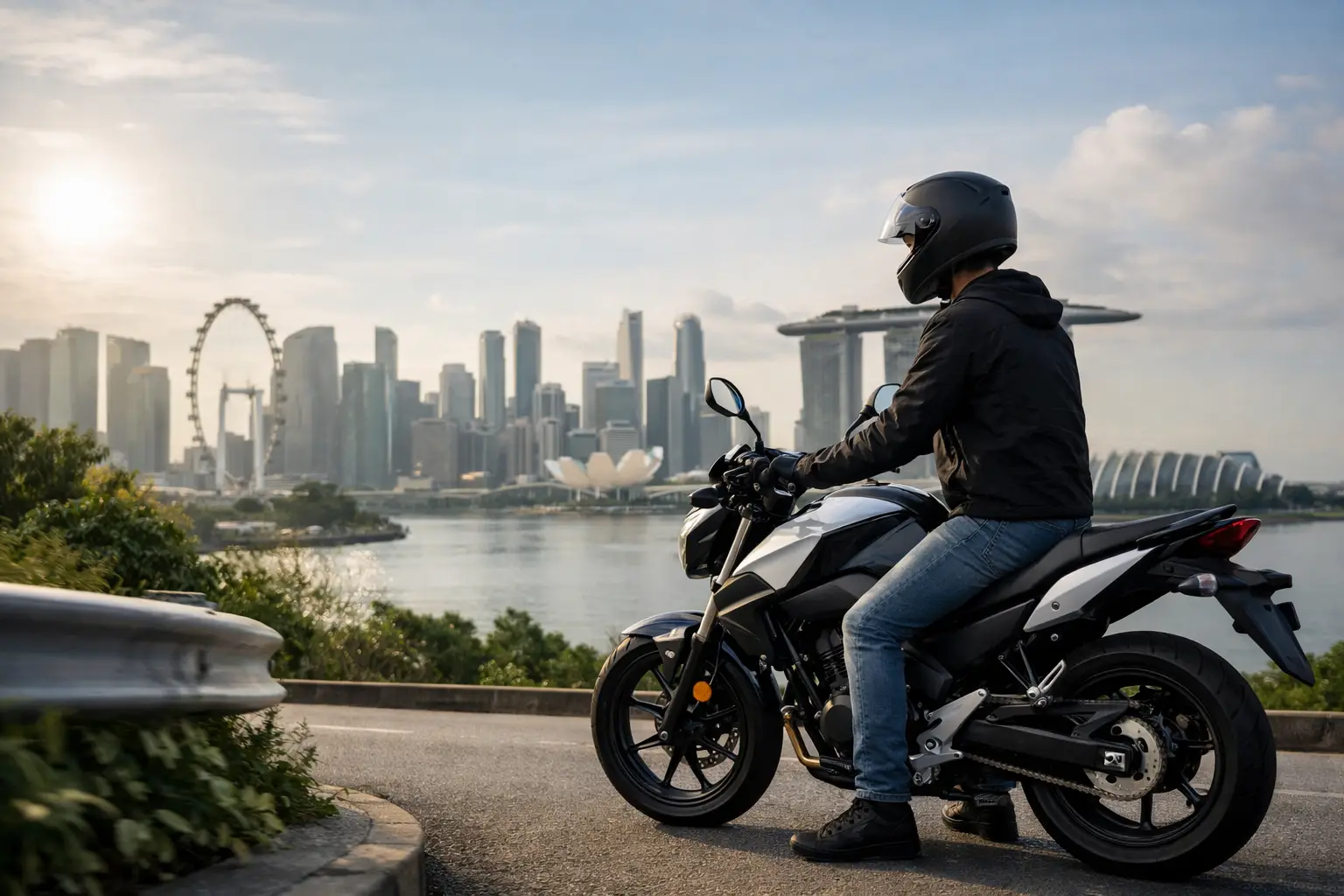
Best Motorcycle for New Riders in Singapore
A motorcycle that feels exciting in a showroom can feel very different when you are balancing it at a crowded Singapore junction in the rain. The best motorcycle for new riders is not automatically the fastest, cheapest, or most stylish option. It is the one you can control calmly, place confidently at low speed, and ride often enough to build real skill.
For most P-plate and Class 2B riders, that means starting with manageable power, sensible weight, an upright riding position, and running costs that leave room in your budget for proper gear and practice. A beginner-friendly bike should make daily transport easier, not give you a new problem at every traffic light.
What Makes a Motorcycle Good for a New Rider?
The best beginner motorcycle gives you room to learn without punishing small mistakes. New riders spend a lot of time dealing with slow traffic, tight parking spaces, uneven surfaces, wet roads, and stop-start commuting. Those conditions reveal more about a bike than a short, open-road test ride ever will.
Start with seat height and weight. You do not need both feet completely flat on the ground, but you should be able to stop, steady the bike, and push it around without feeling like it is pulling away from you. A lower, lighter motorcycle is usually less intimidating when making U-turns, filtering through traffic, or parking on a slope.
Power delivery matters just as much as engine size. Smooth, predictable acceleration helps a new rider roll on the throttle cleanly. A bike with sharp response or aggressive power may be fun later, but it can make slow-speed control and wet-weather riding more demanding than necessary.
Comfort is not a luxury. An upright position with relaxed arms and a neutral reach to the handlebars gives you better visibility and control on longer rides. Sport bikes can look appealing, but a forward-leaning position may put more weight on your wrists and make everyday commuting tiring. If the bike hurts after 30 minutes, you are unlikely to enjoy using it every day.
The Best Motorcycle for New Riders Depends on Your Routine
There is no single winner for every rider. Your ideal first bike depends on whether you need a simple commute, plan to carry a passenger, prefer automatic riding, or want a machine that can still feel useful after your confidence grows.
For daily commuting: lightweight naked bikes
A lightweight naked bike is often the safest all-around answer for a new Class 2B rider. Models in the 150cc range, such as the Yamaha MT-15 or Honda CB150R class of motorcycle, usually offer a manageable riding position, enough acceleration for city roads, and easy handling in traffic.
Their biggest advantage is control. You sit upright, see ahead more clearly, and can turn the handlebars more easily at low speed than on many fully faired sport bikes. They are also practical for riders who need to filter carefully through rush-hour traffic and park in limited space.
The trade-off is wind protection. On faster stretches of road, you will feel more wind than you would behind a fairing. For most urban commuters, though, that is a reasonable exchange for better comfort and maneuverability.
For riders who want a sportier look: beginner sport bikes
A small-displacement sport bike, such as a Yamaha R15 class model, can be a good fit if you genuinely prefer its styling and are comfortable with its riding position. These bikes are generally far more approachable than larger supersport motorcycles. Their power is usable, their size is manageable, and the fairing provides some wind protection.
Still, do not choose one purely because it looks fast. Check how your wrists, knees, and back feel while seated. Practice tight turns and slow stops before committing. A sport bike can be a solid first choice, but it is best for riders who enjoy the position rather than those trying to impress friends at the coffee shop.
For maximum convenience: automatic scooters
For some new riders, an automatic scooter is the most practical first motorcycle. Models in the 155cc to 160cc category, including scooters similar to the Yamaha NMAX or Honda ADV160, remove clutch and gear-change work from the equation. That lets you focus more attention on scanning traffic, braking smoothly, and positioning yourself safely.
Scooters are particularly useful for short city trips, errands, and riders who value under-seat storage. They can make wet-weather commuting less stressful too, especially when paired with proper rain gear.
The compromise is that scooters feel different from manual motorcycles. If your long-term goal is to ride manual bikes, you still need to develop confidence with clutch control and gear selection. But for riders who want straightforward transport, automatic can be the right answer, not a lesser one.
For taller riders or rougher roads: small adventure-style bikes
Adventure-style motorcycles have an upright position, broad handlebars, and a commanding view of traffic. Smaller-capacity versions can suit taller riders or anyone who prefers a more relaxed posture. They also tend to handle uneven road surfaces comfortably.
However, their taller seat height and wider body can be a challenge for shorter or less confident riders at stops. Before choosing one, make sure you can control it easily in a car park, not just while it is moving. The best first bike should feel cooperative from the moment you roll it off the stand.
Do Not Chase Engine Size Too Early
A common mistake is treating a larger engine as an automatic upgrade. More capacity can bring stronger acceleration, extra weight, higher fuel use, and potentially higher repair costs. None of those things automatically make a rider better.
Class 2B motorcycles are more than capable of handling everyday Singapore travel. A smaller bike also rewards good technique. You learn to use the clutch cleanly, choose the right gear, brake progressively, and keep momentum through traffic without relying on excessive power.
When you eventually move to Class 2A or Class 2, your experience will make the change easier. Until then, a manageable motorcycle is not a temporary compromise. It is a smart platform for building habits that matter on every bike you ride later.
Check These Five Things Before You Ride Away
A model name alone cannot tell you whether a motorcycle fits you. Before renting, leasing, or buying, assess the bike in person and give yourself time to notice how it behaves.
- Low-speed balance: Can you start, stop, turn, and walk the bike without straining?
- Reach: Can you operate the clutch, front brake, rear brake, and controls naturally?
- Visibility: Do the mirrors give you a useful rear view without forcing an awkward posture?
- Braking feel: Are the brakes progressive and easy for you to modulate, rather than overly abrupt?
- Daily practicality: Consider fuel use, storage, passenger needs, parking, and how often you expect to ride in rain.
Also look at the condition of the actual motorcycle, especially if you are renting. Tires, brakes, lights, chain condition, and mirrors are not minor details. A well-maintained bike gives a beginner more predictable feedback, which is exactly what you need while developing confidence.
Renting First Can Save You From the Wrong Choice
New riders often feel pressure to buy quickly. But a short-term or extended rental gives you a useful reality check before taking on ownership costs. A bike that feels comfortable for 10 minutes may not suit your commute, your height, or your parking situation after a full week.
Try the type of motorcycle you are considering in real conditions. Ride it during normal traffic, stop on slopes, carry your usual bag, and see how it feels after work when you are tired. That experience can prevent an expensive decision based on looks or online reviews.
For riders in Singapore, Vroom Leasing offers maintained motorcycles across Class 2B, Class 2A, and Class 2 categories, with flexible rental options and roadside support when you need it. It is a practical way to gain seat time without rushing into a long-term commitment.
Build Confidence Alongside the Right Bike
Even the most beginner-friendly motorcycle cannot replace good habits. Start by practicing smooth clutch release, controlled braking, slow turns, and emergency stops in a safe, open area. Keep your eyes up through corners, leave space from the vehicle ahead, and assume wet painted lines and metal covers may be slippery.
Wear a properly fitted helmet every ride, along with gloves, covered footwear, and protective clothing that suits the weather. Singapore heat can make full gear feel inconvenient, but road rash and hand injuries are more inconvenient. Choose breathable gear you will actually use consistently.
Your first motorcycle does not need to be your forever motorcycle. It only needs to help you become a calmer, more capable rider. Choose the bike that feels easy to control on an ordinary Tuesday morning, and every weekend ride will feel better too.
Can Motorcycles Use Bus Lanes in Singapore? - Vroom Leasing says:
September 15, 2026[…] newer riders, a bus lane can feel easier because it may be less congested than the general lanes. That does not […]